Projection Mapping, Dorman Museum, and a Lesson in Letting Go
Feb 13, 2026
One of the most satisfying parts of a project is getting the ball rolling.
Being a ‘creative catalyst’ (bear with me on the buzzword) is something that comes with the territory when your role is to identify solutions that don’t already exist, finding creative solutions to challenges.
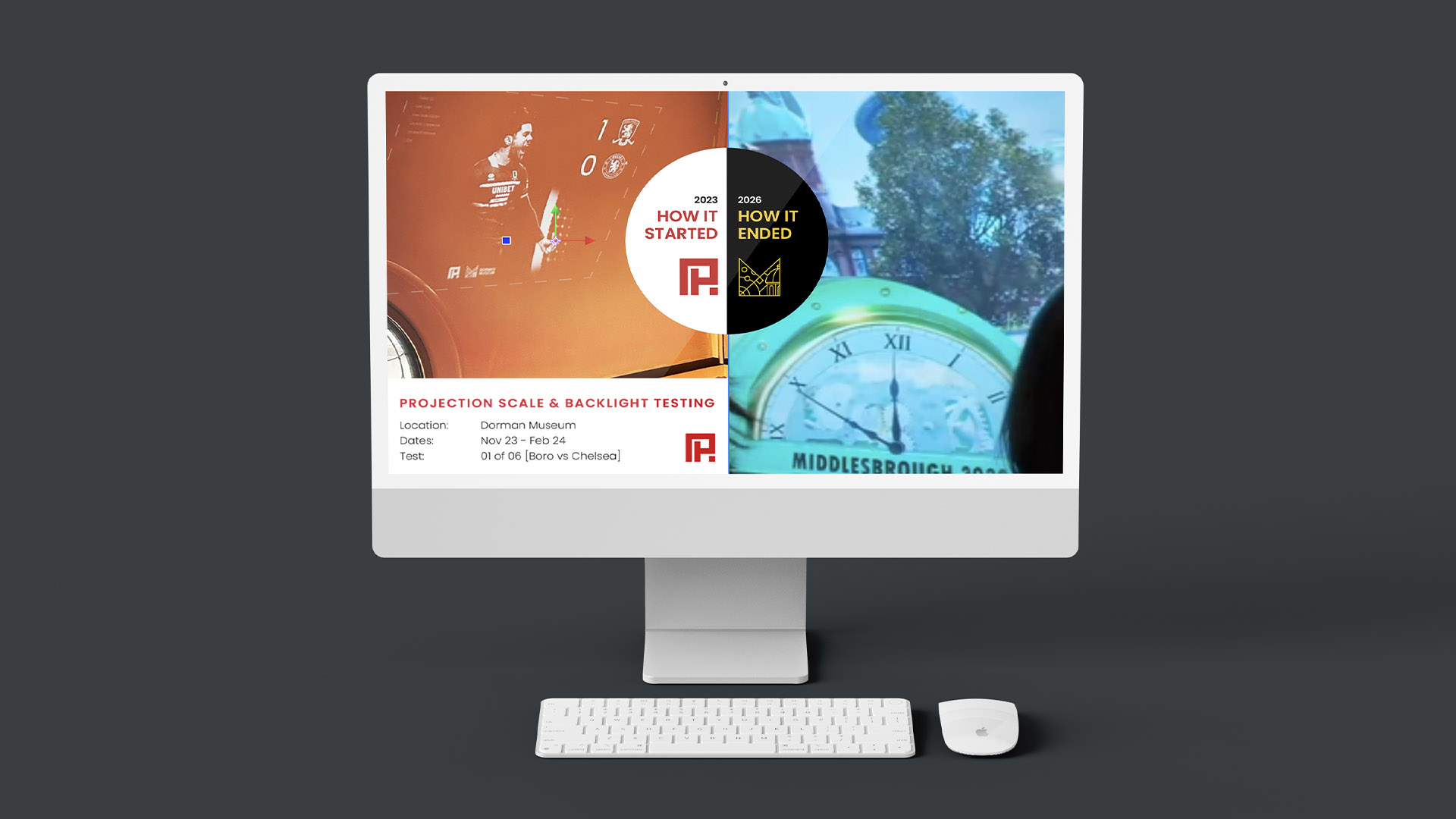
Not every idea ends up being something you get to fully produce… but planting the seed that grows is often reward enough. This week Middlesbrough Museums released footage of a new projection-mapped exhibit at the Dorman Museum, created in collaboration with Teesside University. It looks great. And it’s something I’ve been sitting on for a few years — because, being honest, the idea started with me, growing out of the logo & branding project I delivered back in 2021.
I’m sharing the full story, partly because it’s an interesting one, and partly because as a freelancer whose work is built on bringing original ideas to clients, it’s worth having on record for Peter Hinton Design.
How It Started
About three years ago I was commissioned to create the logo and brand identity for Middlesbrough Museums, the group responsible for both the Dorman Museum and Captain Cook Birthplace Museum. Projects like that one are great because they take you somewhere. I visited the museum regularly throughout, got to know the small team there, and started to understand the place properly.
One of the things you quickly appreciate is the challenge of running a museum on a tight council budget. The main galleries at the Dorman were largely the same ones I’d visited as a kid thirty years ago. Not through any lack of ambition on the team’s part… replacing or updating permanent exhibits is expensive, and certain displays are protected by laws and covenants that limit what can be changed. It’s a situation plenty of regional museums across the country will recognise.
The Idea
The Dorman has a large central gallery with a walkway spanning the void at second-floor level, and above it a wide, gently curved four-sided roof, painted white. Every time I visited I found myself looking up at it.
The idea I put to the team was projection mapping across that ceiling. Rather than being stuck with exhibits that couldn’t be changed, the space could host rotating digital installations… themed around current exhibitions, seasonal content, local history, or entirely new commissions. A programmable gallery, built into the space they already had.
I also suggested an interactive element: a WebSocket-based system where visitors could engage with the installation in real time from their smartphones by scanning a QR code. The goal was to make it genuinely participatory, not just something people watched from below.
The team were enthusiastic. The digital side of things was firmly in my wheelhouse, so over the winter a couple of years ago I put together a working proof of concept to take back to the museum. Example videos, interactive web pages, graphical elements… all demonstrated on-site using their existing projectors, just to show the potential and give the conversations something real to work from.
Where Things Got Complicated
I’d always been upfront that hardware wasn’t my world. Specifying and installing the right projectors, cabling, the physical rig… we’d need a specialist company to handle that side of it. Between us we reached out to a few local firms, but each one ended up being a dead end. The museum mentioned they’d try contacting Teesside University to see if there was potential for a collaboration.
After that, I didn’t hear anything. I followed up by email around six months later, got no response, and assumed the project had quietly been shelved. Given everything a small council museum is juggling, that felt like the most likely explanation. I didn’t chase further.
Seeing It Done
So this week’s announcement was a genuine surprise. It hadn’t stalled at all… it had just carried on without me. My honest reaction was a mix of things. A little frustration, yes. But mostly I’m pleased it exists. The museum has a genuinely innovative exhibit it wouldn’t otherwise have had, and that’s a good outcome.
I don’t think anyone set out to cut me out of it. My best guess is that once Teesside University got involved, their own teams and processes took over, and I was simply lost in the handover. These things happen.
It’s not the first time I’ve been the starting point for a digital project in Middlesbrough without being the one to finish it or get the credit. Middlesbrough is a region with a lot of potential, and if I can help push something forward… even quietly, even without my name on it… I’ll take that.
Why Write This at All?
Most of my work is with small businesses and SMEs, and a lot of it involves finding creative, sometimes unconventional solutions to their problems. AR event stands, interactive animations, gamification of typically dry corporate tools… the kind of projects that work because they can be thought through and delivered end-to-end by one person, without the overhead of an agency or the limitations of an off-the-shelf product. The ability to think a bit differently and actually build what you imagine is a useful combination.
The projection mapping concept for Middlesbrough Museums was developed, proposed, and prototyped by me. The outcome is a good one for the museum and for the city. Both things can be true.
This post is simply my record of where this particular idea came from. If you’re working on something where that kind of thinking might be useful, feel free to get in touch.